Sometimes, in Indian politics, a bill that is dead is worth more than one that is alive.
The Women’s Reservation Bill has failed in Parliament. At first glance, this looks like a loss: a setback for gender equality and a missed chance to change the makeup of India’s legislative bodies. But if you look a little more closely at the political math, you start to wonder if passing it was ever really the goal.
There are different rules for the optics game.
There is a common Hindi saying that sums up the logic perfectly: Zinda haathi laakh ka, mara haathi sava laakh ka. A living elephant is worth a lakh, and a dead one is worth even more. The body has value, whether it’s in ivory, hide, or the stories that people tell about it.
The Women’s Reservation Bill has failed, but it is now a dead elephant that is worth much more than it would have been if it had quietly passed, been put into action, and faded into the bureaucratic routine of government.
It becomes policy when a bill passes. People look closely at it. Delays in implementation are brought to light. The beneficiaries, in this case women, start to hold the government responsible for results, not just words. The bill goes from being a political asset to a problem for the government.
When a bill doesn’t pass? It turns into a weapon. For an indefinite amount of time.
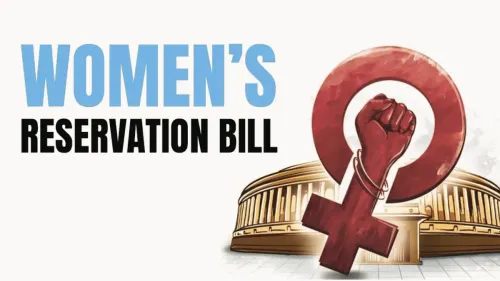
From Laws to Bullets
Think about what the ruling party has now. At every campaign rally and every bhashan from now until the next general election, the story writes itself: “We tried to give women their rightful place in Parliament.” We were stopped by the other side.
How nuanced the actual parliamentary proceedings were doesn’t matter. It doesn’t matter if the bill failed because of disagreements about the process, a lack of a quorum, or coalition politics. In the grammar of electoral communication, all the complicated parts come together to make one strong sentence. And that sentence, “The opposition is anti-women,” is worth more than any policy paper.
This is not a new set of rules. Ambitious legislation that faces resistance has repeatedly been weaponized in exactly this fashion across democracies. The trick is to make the bill dramatic enough to get people talking, sympathetic enough to make people angry, and just complicated enough that the other side can easily be blamed for its failure.
The Structure of Performative Politics
What we’re seeing is a complex, if cynical, type of political theater that works on three levels at the same time.
The optics level is the most clear. People think the government is fighting for women’s rights. The work was done. The goal was good. People will tell this story over and over again.
The real return on investment (ROI) is at the electoral level. About half of the people who vote are women. A story that makes the ruling party look like their champions and the opposition look like their oppressors is a great tool for elections. It doesn’t need to be put into action. It just needs to be repeated.
The level of avoiding accountability is the least talked about. If the bill had passed, the government would have been in charge of putting it into action, including the timelines, the redistricting of constituencies, and the actual increase in the number of women in government. That can be measured. That makes people question it. A bill that doesn’t pass doesn’t ask for any of that.
To put it simply, the bill’s failure gives the ruling party the moral high ground without the extra work.
What the Opposition Found
To be fair to the other side, they were never in a good place. If you vote for the bill, you give the government a win in the legislature and political credit. If you don’t support it or let things get out of hand and it fails, you give them a martyr story.
This is the kind of trap that is easier to see after the fact. The government put forward a bill that was either a real attempt at reform or a very smart political move. From the outside, the two look almost the same until the bill fails.
Now, every opposition leader who spoke out against the bill, raised procedural concerns, or didn’t vote will be called a villain in the next election cycle’s campaign materials. WhatsApp forwards will show their words, which are short and out of context. There will be a count of their absence and a broadcast.
They are figuring out how much the dead elephant is worth.
The Deeper Cost That No One Is Counting
Even though we admire the political strategy for how well it was made, it’s worth taking a moment to think about what was actually lost.
When it comes to women, India’s Parliament is still one of the least representative in the world. Only about 15% of Lok Sabha members are women. This is much lower than the percentages in Rwanda (61%), Iceland (47%), or even Bangladesh (21%). There is no debate about the fact that women are not well represented in Indian legislatures. It is a documented, quantifiable failure of democratic inclusion.
Every election cycle that doesn’t bring about real structural change is one in which about half of the population is still systematically kept out of the rooms where decisions are made. The Women’s Reservation Bill, no matter how it was politically packaged, dealt with a real problem.
Because it failed—on purpose, by accident, or some combination of the two—the problem goes on.
The mara haathi is really worth a lot. But somehow, the elephant has been left out of this accounting.
The Question That Needs to Be Asked
The most important question this episode leaves behind is not whether the ruling party will use this well in future campaigns. Yes, they will. The question is whether Indian voters, especially women, will be able to tell the difference between a government that fights for them and one that fights with them as a prop.
Politically, the bill’s death was helpful. The cause it was meant to serve is still very much alive, still important, and still waiting. No matter what party forms the next government, it will have to deal with the same structural issue.
Will they respond with laws or with a funeral?