Think of a single narrow strip of water that is only 30 miles wide at its tightest point and controls 20% of the world’s oil supply. It is a place where one mistake can cause fuel prices to go up or down overnight. The Strait of Hormuz is that place. And right now, in 2026, it’s at the center of a global crisis that is hurting India, the world economy, and millions of people. Let’s learn about this waterway, from its long history to its current state of being very busy.
What is the Hormuz Strait?
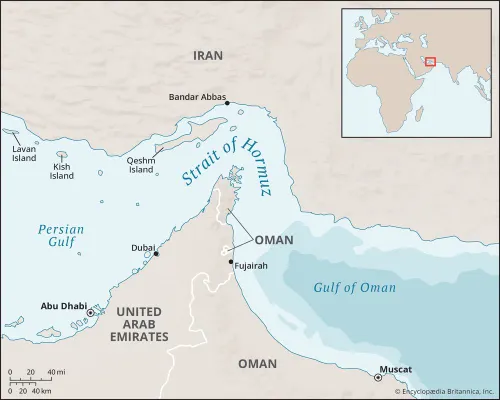
The Strait of Hormuz is one of the world’s most strategically important choke points, being the only route from the Persian Gulf to the open ocean. About 20% of the world’s liquefied natural gas and 25% of all oil trade by sea went through it every year from 2023 to 2025. Wikipedia says it is between Iran to the north and Oman and the UAE to the south. Saudi Arabia, Kuwait, Iraq, Qatar, and the UAE are some of the biggest oil producers in the world. Most of their cargo goes through the Strait on tankers. Time The Strait has been around for thousands of years and has always been a hub for maritime trade, connecting the Middle East with India first and foremost. HISTORICAL Long before oil was found, traders, explorers, and empires sailed through these waters. People didn’t find oil in the Gulf until the early 1900s. Thereafter, the Strait of Hormuz went from being a busy trade route to being the lifeblood of the modern world economy.
Iran’s Weapon of Choice: Decades of Tension
Iran has said it controls the Strait of Hormuz since the 1979 Iranian Revolution, which overthrew the American-backed Shah and set up the Islamic Republic. The Past: Since then, Tehran has used the threat of closing the Strait as a way to get what it wants from the West.
During the Iran-Iraq War in the 1980s, both sides attacked oil tankers in the Gulf. This is what historians call the “Tanker War.” The US military stepped in to keep shipping lanes safe. In 2012, when nuclear sanctions were made stricter; in 2018, during Trump’s “maximum pressure” campaign; and in 2019, when Iranian forces attacked or seized several tankers, tensions rose again. The world held its breath each time, and oil prices went up.
The Strait had never been closed for a long time during Middle Eastern wars, though, until 2026.
The 2026 Crisis: When the Threats Came True
The US and Israel started an air war against Iran on February 28, 2026, and killed its supreme leader, Ali Khamenei. In response, Iran’s Islamic Revolutionary Guard Corps started warning ships not to pass through the Strait, confirmed attacks on merchant ships, and allegedly laid sea mines in the waterway. Wikipedia: “The Strait is closed,” said a high-ranking IRGC adviser on March 2, 2026. The Revolutionary Guards will set those ships on fire if anyone tries to pass. THE PAST Iran followed through on its threats and blocked most shipping traffic through the Strait. The decision to cut off oil exports from Iraq, Kuwait, Qatar, Saudi Arabia, and the UAE sent oil prices around the world soaring. Iran’s continued stranglehold on the flow of oil and gas has thrown the global economy into chaos, making energy prices very unstable all over the world. Time
What This Means for India
This crisis has a very strong impact on India. Japan’s refiners get about 95% of their crude oil from Gulf countries, and 70% of that comes through the Strait. India is in a similar situation. Wikipedia India gets more than 85% of its crude oil from other countries, and a lot of it comes from the Gulf. Iran’s foreign minister said on March 26 that ships from India, China, Russia, Iraq, and Pakistan would be able to pass through the Strait (Wikipedia). This was a relief for India, but the situation is still unclear. People in India are worried about the prices of fuel, inflation, and the costs of shipping.
What Comes Next?
The US started an air campaign against Iranian targets on March 19, 2026, to reopen the Strait of Hormuz. Wikipedia: On April 7, the U.S. and Iran agreed to a two-week ceasefire. Trump said it would only happen if the strait opened completely, immediately, and safely, but that didn’t happen. Today, April 18, 2026, the situation is still unstable and unresolved. There is still some danger in the world’s most important waterway, even though diplomacy is still going on.
In conclusion
The Strait of Hormuz isn’t just a lesson in geography; it’s a reminder of how connected our world is. A small body of water in the Middle East can raise your fuel bill in Nagpur, mess up supply chains in Mumbai, and make economies less stable from Tokyo to London. The crisis of 2026 has made decades of warnings come true. No matter what happens next, whether there is peace or more fighting, one thing is certain: whoever controls the Strait of Hormuz has a lot of power over the whole world.
Should India be more involved in finding a diplomatic solution to the Hormuz crisis? Please leave your thoughts in the comments section below! 👇 Or Contact Us